Showing posts with label education. Show all posts

Sunday, March 29, 2020

Sketches of Nature – Environmental education through art

Cacao tree
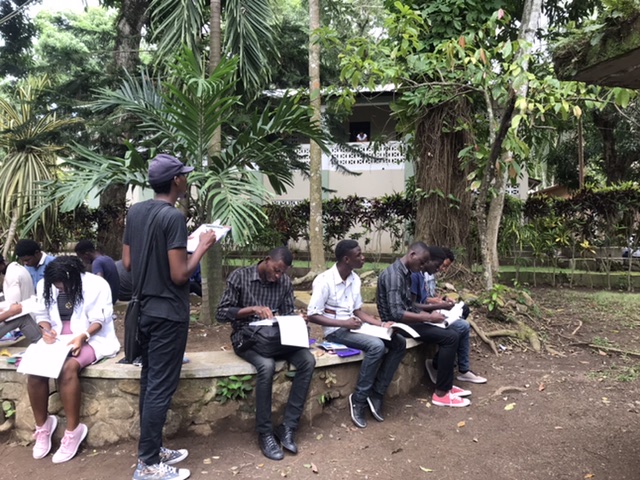
On Thursday March 19 2020 I begun an art and nature activity funded by the Cape Cod Bird Club Conservation fund. The objective of the project is to engage Université Chrétienne du Nord d'Haïti (UCNH) School of Fine Arts students with nature through directed activities of sketching nature and composing poetry and songs, and help them pass these skills along to children in the surrounding community through an art and nature workshop that they plan and direct. The ultimate goal is to link participants to nature to increase their awareness of the environment and conservation needs.

Funding allowed me to bring art supplies for 12 students (sketch books, color pencils, and graphite pencil kits). Fine Arts student Ruben stepped up as a leader and organized the students. The first workshop was 2 hours long and we sat outside on campus and sketched a cacao tree and leaves. At the end I gave the students two assignments – return next week with a drawing of flowers, and a drawing of something that wasn’t a plant. At the next meeting we would plan a Saturday morning children’s art workshop.


Little did I know that while we met, Haiti was closing its borders due to two confirmed cases of COVID19 and the US Embassy was recalling all overseas citizens back to the US. I returned to my campus house to find the messages and immediately bought an airline ticket for return to the US. The next meeting will have to wait until I return to campus, perhaps this fall or next spring semester. I hope the art supplies will give the students a creative outlet while the university and everything else is closed. I have asked Ruben to send me pictures of the students’ art work. And the supplies for the children’s program are safely stored in Haiti.


Monday, February 24, 2020

Cap Haitien Universite Louverturienne d'Haiti

My ecology student arranged for us to teach a bird class at Universite Louverturienne d'Haiti in Cap Haitien, Since it was mainly administration students, I focused on the economic importance of birds in Haiti and ecotourism. 40 students attended, including some agriculture and nursing students. When he saw my computer and projector, the professor graciously acquired some diesel to run the generator so we could have current. I gave some posters provided by Birds Caribbean. FYI we left my house at 10am and got home at 5pm, all to teach a 2 hour class 15 miles away. The road and traffic are that bad (we did spend an hr on lunch and a bank stop)!

At the intersection of 23 & F.


Sunday, January 6, 2019

Environmental Education in Haut Limbe

Evangelic Baptiste
In Nov. 2018 my translator and I started going to schools in Haut Limbe to teach about the importance of birds in Haiti’s environment. As in other communities, the children’s first response to the question “Do you like hawks” is “no, they eat chickens!” We explain that hawks eat many more mice and rats than chickens, and also talk about the importance of parakeets to spreading seeds and hummingbirds in pollinating. Many boys have killed birds with slingshots, including my translator. He regrets this saying he wouldn’t have done this if only he knew that birds were important! So we are on an anti-slingshot campaign. Most of this kids in the 10 or so schools in the area know who he is and have starting telling on each other! I will keep track of our progress in future blogs.
Bon Berger (Limbe)
Bon Le Berger Kindergarten
Emmaus du Haut Limbe
Limbe Academy


Tuesday, February 13, 2018

Environmental meters for an ecology class in Haiti

Light meters
Each semester I take my Eco-201 students to the waterfall Bassin Zim near Hinche to practice a bioassessment of the watershed.  This year I used several models of environmental meters.  I had been using the Sper Scientific meter that has 4 instruments in one: temperature, % relative humidity (RH), wind, and light.  I first used this meter at the Amazon Academy in the Peruvian rain forest, where light levels do not exceed the maximum reading of 20,000 lux.  However, light levels in Haiti are higher, thus my quest to test other meters. Also the Sper meter has hold and mx/min buttons that put the readings on pause that can only be canceled by pushing certain buttons for 2 seconds. This confounds the students. Thus I purchased 3 different light meters, and 2 different anemometers (wind meter).  Here are the reviews of their use with university students in Haiti, with the color to match to the photo.  From the price you can see it is cheaper to buy light and wind meters separately.  I underlined the features I prefer.

Wind meters


Sper Scientific meter – 4 instruments, max of 20,000 lux is too low, numbers get stuck – have to press proper button 2 sec. to exit mode. Wind, temperature, and rH works fine.  Has case. Need screw driver to access 9v battery. $126.54 on Amazon Dec. 2016. Gray.

UNI-T UT383 light meter – Only light in lux or fc, max 199,999 lux. Easy to turn off hold and max/min. No case, unprotected light probe. Easy access to 3 AAA batteries. $21.99 on Amazon Dec. 2017. Red.

URCERI MT-912 light meter – Temperature and light (lux or fc), max 200,000 lux. Hold min/max 2 sec. to turn off, press hold once to turn off. Back-lit screen (will this use up batteries?). No case, attached cover for light probe! Easy access to 3 AAA batteries. $19.99 on Amazon Dec. 2017. Yellow.

Leaton Lux Meter L830 – Only light in lux or fc, max 200,000 lux. Easy to turn off hold and max/min. No case, cover for light probe. Easy access to 9v battery. Gray.

PEAKMETER MS6252B Digital Anemometer – Also has temperature and RH. Six choices for wind units: knots, m/s, km/h, mil/h, ft/m, ft/s. Backlight option. Comes with case, need screwdriver to access 9v battery. Comes with cable to download to computer. $39.95 on Amazon Dec. 2017! Yellow.


MASTECH MS625B Digital Anemometer – Exactly like PEAKMETER except green. $50.98 on Amazon Dec. 2017. Green.

Thursday, January 25, 2018

BirdSleuth Caribbean for UCC preschool

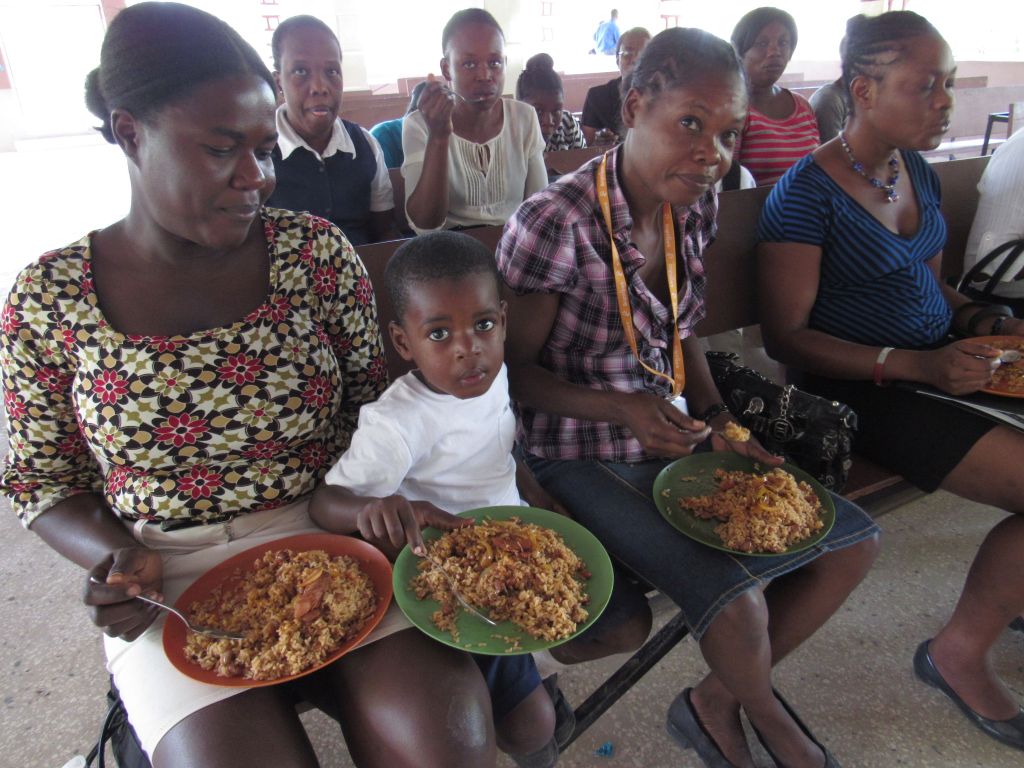
Last week I led the first BirdSleuth seminar for the preschool teachers at UCC in Caiman.  13 teachers attended, with 2 of their children who were great for demonstrating teaching techniques.  We began with a 40 minute presentation about the importance of birds, showing photos on my ipad of birds found in Haiti.  After lunch of rice and beans with onion sauce, we began the games.  I gave each teacher a habitat and a bingo card, and showed how activities can be scaled from preschool to older kids.  My translator Donacien and I demonstrated the habitat and survivor games, then all joined in and had fun playing them.  I gave the preschool a BirdSleuth manual and set of survivor, scavenger hunt, and bingo cards for their resource room.  The elementary school principle is now asking that I give a workshop for her teachers!


Wednesday, January 17, 2018

BirdSleuth Caribbean at Wynne Farm

Recently for the staff of Wynne Farm Ecological Reserve in Kenscoff I had the opportunity to teach a 2 hour seminar on the importance of birds and to Haiti share BirdSleuth Caribbean teaching activities.  I met with the 15 participants while my university ecology students took a tour of the reserve and farm.  Participants included Jane Wynne and her daughter Sarah who run the reserve, staff, student interns, and others who had strong ties to the conservation ethic of the farm.


We began with a discussion about the importance of birds in Haiti, including pest control, pollination, seed dispersal, education, ecotourism, and art (including Haitian John James Audubon).  I then introduced the Cornell Ornithology Lab BirdSleuth educational materials sent to me by Birds Caribbean.  We practiced the Habitat and Survivor gamesof Lessons 4 & 5 and feedback helped me improve my use of them.  I gave Wynne Farm two manuals and two sets of the survivor, scavenger hunt, and bingo games.  They gifted me with Rene Durocher’s beautiful Les Oiseaux d’Haiti book of bird photography.  Thank you Wynne Farm and Birds Caribbean!


Tuesday, December 19, 2017

BirdSleuth Caribbean at Bassin Zim

On 8 Dec. 2017 I took my Eco401 class (Biodiversity, juniors) to the waterfall Bassin Zim (near Hinche) so that we could have an ecology program for the children that hang out there. These kids don’t go to school, but instead hang out at the park to earn money helping visitors (see past blogs here).  I take my Eco201 class (freshmen) there to practice bioassessment of the watershed, and wanted to do something different their junior year that would help them learn some teaching techniques, and in turn help the kids at the falls. So we did some BirdSleuth Caribbean activities that we previously practiced in class.


There were 13 university students, plus me and the interpreter, and there were 15 kids (ages 6 to 16?), so after a short introduction about ourselves and the importance of birds, we paired up for the Bird Habitat scavenger hunt.  We then played the bird habitat game in which a ‘bird’ needs to find food, water, shelter and space.  My students and the kids bonded a bit, and stayed together as pairs when we had free time to explore the park.  My students shared their food with the kids.  One of my students found a tiny snake, and did not kill it!  Huge victory for the snakes of Haiti! 


Monday, November 6, 2017

BirdSleuth Caribbean Lessons 4 & 5 – Habitat & Survivor

Habitat elements cover, cover, water, space,
and the bird in the pink dress.
I tried out BirdSleuth Lesson 4 Habitat in my Saturday morning UCI kids ecology program (2 hours, 15 kids, age 2 y.o. through 8th grade) and Lesson 5 Bird Survivor in the 7th grade UCC class (1/2 hr, 16 kids), and figured out what worked, and mostly what didn’t work.  In general, the kids in 6th grade and up weren’t so into the games.  And I realized that my translator and I really needed to demonstrate a round of both games with us as the birds.  Both games worked better when kids stay in their seats and the birds are in front.  Difficulties with habitat were that the kids wouldn’t continue to make the motion of their assigned habitat element (food, water, cover, space) throughout the game, and it didn’t work as a chase game as the birds and their habitat friends formed alliances, so there was not much chasing.  At the end I gave them markers and index cards to write the 4 habitat elements and draw pictures.  The older kids helped the younger ones, and they all seemed to enjoy that.


The Survivor game requires the kids to read cards describing the success of birds in 1. finding territory and 2. mates, 3. building nests and 4. sitting on them, 5. finding food, and 6. fledgings leaving the nest.  The birds standing up front take steps either forward or backwards depending on their success with each step.  First, a teacher wasn’t around and kids were trickling in from break, so they weren’t attentive.  Then I discovered my translator can’t read French very well!  So it was difficult directing the kids through the instructions.  Finally I went up front as the bird and asked kids to read their cards to me.  I understand French well enough to figure out whether to step forward or back.  Then finally the session was over.


I revised both games for the Saturday program in the Bohoc village (2 hrs, 25 kids age 2 – 15).  I wrote in Kreyol the 4 habitat elements and 6 survival components on laminated cards.  And as we explained each, kids came up front to hold the cards.  I assigned habitat elements to kids based on the color of their shirts so I could remember who was what (blue = water, etc.).  And my translator and I demonstrated collecting the 4 elements, making a competition of it to see who could gather all 4 first.  Then we had pairs of kids come up front as birds and race to see who could collect the elements.  For the survivor game, I distributed all cards to the kids, and my translator and I stood up front and in turn asked for the cards for each step in order.  Two older girls who could read French read the cards to us and we explained in Kreyol.  Both games worked much better with this group.  Afterwards the kids wrote the components on the index cards and drew pictures of birds.
Bird survivor components

Writing the habitat elements

Tuesday, November 29, 2016

Bird Sleuth

I teach ecology programs in a rural village in central Haiti, and at an elementary school.  This week we used the BirdSleuth scavenger hunt and Bird Spy Bingo produced by the Cornell Lab of Ornithology.  The games are printed on slick cards on which dry erase markers can be erased.  I only have the English version of the games since I am waiting for the French to be reprinted.  The scavenger hunt has basic and more advanced levels of finding objects in natures such as a spider web, rock, leaf, etc., and is mostly text, so I had the kids find the objects that were pictured on the cards.  Bird bingo has birds doing various things, such as sitting on a branch or singing, and the kids were able to follow the illustrations.  The 6th graders were able to read some of the English descriptions of the birds.  There aren’t many trees in the village and the kids are noisy, but a kestrel did pose on a tree for us, and the kids found a feather and bird droppings.  We saw a few more birds near the elementary school.  Binoculars aren’t needed for the scavenger hunt, but make the bingo more fun.  Both games draw attention to animals and objects found in nature.  My assistant Louiders wants me to thank everyone who donates binoculars and funds for this!  He says you are helping Haiti!

Searching for birds along the village path.
Bird Bingo in the village.


Louiders helping the 6th graders.


Saturday, July 30, 2016

BirdSleuth in French - Zwazo Detektif nan Franse

The Cornell Lab of Ornithology has many birding resources, from educational materials to the eBird on-line database.  In a tropical rain forest class in the Amazon, I had a chance to try out some of their BirdSleuth materials for K-12 grade.  There is a bingo game and a scavenger hunt to get kids outside looking for birds.  You can download the French version of the materials at BirdsCaribbean.

Laboratwa a Cornell nan ornitoloji gen anpil resous gade zwazo, ki soti nan materyèl edikasyonèl nan baz done a eBird sou entènèt. Nan yon klas forè twopikal nan Amazon a, mwen te gen yon chans eseye soti kèk nan materyèl BirdSleuth (K-12). Gen se yon jwèt bengo ak yon lachas trezor yo ka resevwa timoun deyò kap chèche zwazo yo. Ou ka telechaje vèsyon an franse nan materyèl yo nan BirdsCaribbean.
Student in Peru using BirdSleuth Scavenger Hunt.
The BirdSleuth Scavenger Hunt in Spanish.
Using BirdSleuth materials in Peru during the Educator Academy in the Amazon.