Showing posts with label birds. Show all posts

Sunday, April 3, 2022

Return to the mangroves in St. Michel/Camp Louise

In March 2022 I returned to Université Chrétienne du Nord d'Haïti (UCNH) in northern Haiti to reconnect and teach a short biology course. I also visited the mangroves that I surveyed in March 2020 under a small BirdsCaribbean grant. This time, Elio took me to the shore side of the mangroves. We walked the mile-long stretch which was a narrow (<1m) strip of sandy shore covered in plastic trash for almost the entire length. Two of the 3 paths that we followed into the mangroves led to areas cleared for charcoal. We heard several yellow warblers in the mangrove, and saw one sandpiper along the shore, along with washed up pieces of coral and sponges. In the mainland side of the mangrove, we saw glossy ibis, greater yellowlegs, and black-necked stilts.

Sponge


Cleared for charcoal

Spotted sandpiper


Trash on the beach.
Black-necked stilt, glossy ibis, greater yellowlegs in front.


Sunday, May 16, 2021

BirdsCaribbean grant - Environmental education in Camp Louise

Using BirdsCaribbean bird silhouette poster.
Because of the COVID-19 pandemic, Debbie had to leave Haiti in March 2020 and was not able to return as of May 2021. Elio and Wilnise of UCNH continued the activities for this project by leading environmental education workshops for children and their parents of the Institut Rehoboth de Belle Hotesse school which is near the previously monitored mangroves. Snacks were provided! Thank you BirdsCaribbean for funds to do this important outreach. 


 April 28 2021, 8 – 10a Children’s workshop 

Audience: 96 students, 5 teachers, 1 director. (With assistant Wyd)

Theme: Protect birds, mangroves, and the environment. 

Topics: • The importance of birds - How birds make us have plenty of food. Distribute handouts of birds pictures and names. • Protection of birds - Do not litter, do not break their nests, do not kill birds, plant trees, do not use slingshots. 

The parents.

May 12 2021, 12:30 – 2:30p Parent’s workshop. 

Audience: 40 parents, 5 teachers, 1 director. (With assistant Gideon) 

Theme: Protect the mangroves through protecting the environment. 

Topics: • The importance of mangroves. • The importance of birds and how this can lead to better jobs. • Exhort children for killing birds. • Do not cut trees. • Do not litter. 

Elio says: Mwen kwè fòmasyon sa dwe gen swit. Kèk aksyon pou ede timoun ak granmoun yo rebwaze zòn nan. Granmoun yo pare pou kolabore nan jan yo kapab. Mwen te kontan anpil travay nan pwojè sa. Ekip la solid e pare pou kontinye patisipe nan bon chanjman kap fasilite byenèt tout moun ak tout zwazo yo!!!!! 

(I believe this training must follow. Some actions to help children and adults reforest the area. Adults are ready to collaborate as best they can. I was very happy working on this project. The team is strong and ready to continue participating in good changes that facilitate the well-being of everyone and all the birds !!!!!)


Wednesday, April 1, 2020

Scouting the Limbe rice fields - Trip 3

Look closely for the flock of around 80 glossy ibis passing over the rice fields!
17 Mar. 2020 On our way back to UCNH after teaching about birds at Bon Berger school on the outskirts of Limbe, Wilnise, Elio, and I stopped to see the birds that flock to the rice fields along National Route 1. Each morning large flocks of glossy ibis (Plegadis falcinellus) fly from the east to these fields, and each evening return to wherever they roost, perhaps along the Baie de l’Acul. We walked into a small patch of mango trees to find a suitable place to regularly survey with our spotting scope. We saw at least 100 glossy ibis! As well as cattle and great egrets and one green heron.

We planned to return during a morning to spend more time surveying. And also planned to return to the mangroves at Camp Louise that coming Saturday. But two days later on 19 March, two confirmed cases of COVID19 were discovered, Haiti shut down its borders to people entering and exiting the country, and I was left scrambling for a flight back to the US. So this project is on hold until people are able to freely travel in Haiti. Thanks to BirdCaribbean for helping us with this great start! Our conference to train the local school teachers in using BirdSleuth materials is on hold until I can get back to Haiti. In the meantime, I left materials with my assistants so they can commence birding and teaching once the pandemic passes and kids resume school, this fall I hope.

Wilnise and Elio teaching about birds at Bon Berger.

Saturday, March 7, 2020

Camp Louise mangroves – Trips 1 & 2


Site 2 - Main monitoring site
In early 2019 Wilnise and I went with our birding group (Mike, etc.) to do a survey along the road that goes to the Camp Louise beach (edit: Actually the stretch of mangroves between St. Michel and Camp Louise). We stopped at the mangroves and surveyed from the road. Wilnise and I returned a month later and the fields and mangroves were dry – we were able to walk pretty far into the mangroves and saw warblers. I was awarded funding from BirdsCaribbean to continue monitoring this area, train other birders, and have a bird workshop for the children in the area. These are my notes for this work. Bird lists are uploaded to eBird.

19 Feb. 2020 Mini-foray at mangrove next to beach
I did a stationary survey by myself after a swim at the beach. Very small patch of trees, No remarkable birds, cattle and snowy egrets in wet area next to it. Brown pelican flew by on beach.

7 Mar. 2020 First trip to train others
Two trusted motorcycle drivers took Wilnise and me to the mangroves to commence monitoring this year. Our first stop along irrigation canals became muddy so we weren’t able to get in a great spot, but did see both yellowlegs species and some black-necked stilts and killdeer. We moved to a new location that will be our long-term monitoring spot for this mangrove. Rice fields run along it and they are full of water now (previous week had rain almost the entire week).

We then went to the small mangrove that I previously surveyed next to the beach, and saw a green heron perched on top of a bush. Then walked north along the beach to a rocky tip. A remnant mangrove runs along the beach, we recorded the clear song of a yellow warbler. We saw 2 spotted sandpipers bobbing their tails along the ocean shore. In the back area of the mangrove where trees were cut so now it’s only a mudflat, we saw 2 Wilson’s plovers chasing little crabs. The motorcycle drivers Wid and Carlo took to spotting the birds, and I think are candidates for training to be guides. Wilnise asked the men in the snack shacks along the beach who to contact for arranging a kids bird camp.

Lesser and greater yellowlegs

The team at site 2 - main site
 
Site 3 - the little mangrove right at the beach

Site 4 - destroyed mangrove on left (remnant on right off of photo)

Spotted sandpiper at site 4

Wilson's plover at site 4 - in the mudflat that once was a mangrove


Monday, February 24, 2020

Cap Haitien Universite Louverturienne d'Haiti

My ecology student arranged for us to teach a bird class at Universite Louverturienne d'Haiti in Cap Haitien, Since it was mainly administration students, I focused on the economic importance of birds in Haiti and ecotourism. 40 students attended, including some agriculture and nursing students. When he saw my computer and projector, the professor graciously acquired some diesel to run the generator so we could have current. I gave some posters provided by Birds Caribbean. FYI we left my house at 10am and got home at 5pm, all to teach a 2 hour class 15 miles away. The road and traffic are that bad (we did spend an hr on lunch and a bank stop)!

At the intersection of 23 & F.


Monday, November 6, 2017

BirdSleuth Caribbean Lessons 4 & 5 – Habitat & Survivor

Habitat elements cover, cover, water, space,
and the bird in the pink dress.
I tried out BirdSleuth Lesson 4 Habitat in my Saturday morning UCI kids ecology program (2 hours, 15 kids, age 2 y.o. through 8th grade) and Lesson 5 Bird Survivor in the 7th grade UCC class (1/2 hr, 16 kids), and figured out what worked, and mostly what didn’t work.  In general, the kids in 6th grade and up weren’t so into the games.  And I realized that my translator and I really needed to demonstrate a round of both games with us as the birds.  Both games worked better when kids stay in their seats and the birds are in front.  Difficulties with habitat were that the kids wouldn’t continue to make the motion of their assigned habitat element (food, water, cover, space) throughout the game, and it didn’t work as a chase game as the birds and their habitat friends formed alliances, so there was not much chasing.  At the end I gave them markers and index cards to write the 4 habitat elements and draw pictures.  The older kids helped the younger ones, and they all seemed to enjoy that.


The Survivor game requires the kids to read cards describing the success of birds in 1. finding territory and 2. mates, 3. building nests and 4. sitting on them, 5. finding food, and 6. fledgings leaving the nest.  The birds standing up front take steps either forward or backwards depending on their success with each step.  First, a teacher wasn’t around and kids were trickling in from break, so they weren’t attentive.  Then I discovered my translator can’t read French very well!  So it was difficult directing the kids through the instructions.  Finally I went up front as the bird and asked kids to read their cards to me.  I understand French well enough to figure out whether to step forward or back.  Then finally the session was over.


I revised both games for the Saturday program in the Bohoc village (2 hrs, 25 kids age 2 – 15).  I wrote in Kreyol the 4 habitat elements and 6 survival components on laminated cards.  And as we explained each, kids came up front to hold the cards.  I assigned habitat elements to kids based on the color of their shirts so I could remember who was what (blue = water, etc.).  And my translator and I demonstrated collecting the 4 elements, making a competition of it to see who could gather all 4 first.  Then we had pairs of kids come up front as birds and race to see who could collect the elements.  For the survivor game, I distributed all cards to the kids, and my translator and I stood up front and in turn asked for the cards for each step in order.  Two older girls who could read French read the cards to us and we explained in Kreyol.  Both games worked much better with this group.  Afterwards the kids wrote the components on the index cards and drew pictures of birds.
Bird survivor components

Writing the habitat elements

Saturday, October 21, 2017

BirdSleuth Caribbean Lessons 7 & 8

Birds Caribbean sent me materials written in French to lead a BirdSleuth Caribbean class for teachers in Haiti.  Before having a workshop for teachers, I am trying out the material on kids in area elementary schools.  The first lesson was a 1.5 hr Saturday morning program in two different rural villages with kids aged 2 to 15 years old.  I began with the poster of bird silhouettes to identify birds and discuss different groups. (I didn't follow all the  dialogue of the lesson or take kids out with binoculars).  From the first group I learned that the kids didn't know what a silhouette is (even though they speak French), so explained it to the second group as a shadow, and better explained that we don't need binoculars to identify birds, but can use their shape.  They understood this as the hummingbird has a long beak, the woodpecker is on the side of a tree, etc.  The kids didn't know the wading bird silhouette, and I have never seen any in this area.  We called it the kolye, the name for plover and killdeer. They also mentioned crow several times, but it is not on the poster.  They gave me the Haitian Creole names of the birds.  Then volunteers come up front and faced away from the poster to try to name all 10 types of birds on the poster.

Next we used the bird body part poster of Lesson 8.  Students gave me the Creole names of the parts, then I had volunteers come up front in pairs and the 'scientist' showed us the parts on their 'bird.'  We looked at the bird illustrations in the Haiti bird guide, and I asked the kids questions like what color is the eye stripe, or which bird has a black throat.

We then went into the surrounding and used the beginner side of the scavenger hunt cards (after emphasizing that they only use the dry erase markers on the cards).  They had played this came last year using the English language version and searching for only the illustrated items, so I thought with the French version at least the older kids would look for more items since some are described only with text.  But in both groups all the kids stuck to looking for only the illustrated items.  So when I have lessons with only the older kids I will emphasize the written items.  Stay posted for the results of future lessons.


Tuesday, November 29, 2016

Bird Sleuth

I teach ecology programs in a rural village in central Haiti, and at an elementary school.  This week we used the BirdSleuth scavenger hunt and Bird Spy Bingo produced by the Cornell Lab of Ornithology.  The games are printed on slick cards on which dry erase markers can be erased.  I only have the English version of the games since I am waiting for the French to be reprinted.  The scavenger hunt has basic and more advanced levels of finding objects in natures such as a spider web, rock, leaf, etc., and is mostly text, so I had the kids find the objects that were pictured on the cards.  Bird bingo has birds doing various things, such as sitting on a branch or singing, and the kids were able to follow the illustrations.  The 6th graders were able to read some of the English descriptions of the birds.  There aren’t many trees in the village and the kids are noisy, but a kestrel did pose on a tree for us, and the kids found a feather and bird droppings.  We saw a few more birds near the elementary school.  Binoculars aren’t needed for the scavenger hunt, but make the bingo more fun.  Both games draw attention to animals and objects found in nature.  My assistant Louiders wants me to thank everyone who donates binoculars and funds for this!  He says you are helping Haiti!

Searching for birds along the village path.
Bird Bingo in the village.


Louiders helping the 6th graders.


Saturday, July 30, 2016

BirdSleuth in French - Zwazo Detektif nan Franse

The Cornell Lab of Ornithology has many birding resources, from educational materials to the eBird on-line database.  In a tropical rain forest class in the Amazon, I had a chance to try out some of their BirdSleuth materials for K-12 grade.  There is a bingo game and a scavenger hunt to get kids outside looking for birds.  You can download the French version of the materials at BirdsCaribbean.

Laboratwa a Cornell nan ornitoloji gen anpil resous gade zwazo, ki soti nan materyèl edikasyonèl nan baz done a eBird sou entènèt. Nan yon klas forè twopikal nan Amazon a, mwen te gen yon chans eseye soti kèk nan materyèl BirdSleuth (K-12). Gen se yon jwèt bengo ak yon lachas trezor yo ka resevwa timoun deyò kap chèche zwazo yo. Ou ka telechaje vèsyon an franse nan materyèl yo nan BirdsCaribbean.
Student in Peru using BirdSleuth Scavenger Hunt.
The BirdSleuth Scavenger Hunt in Spanish.
Using BirdSleuth materials in Peru during the Educator Academy in the Amazon.

Monday, February 1, 2016

House sparrows in Caiman

Yesterday (31 Jan. 2016) was the first time I noticed house sparrows Passer domesticus in Caiman in Haiti’s central plateau (8 miles east of Pignon).  Here are photos of their nest on the campus of UCCC.  One male and 2 females or perhaps immature males.  The Birds of the DR and Haiti book says their first recorded appearance on the island was in 1976 in the DR.

Male and the 2 females or immatures next to their nest.

Female or immature?


They are in a tree near this sign.


Saturday, December 19, 2015

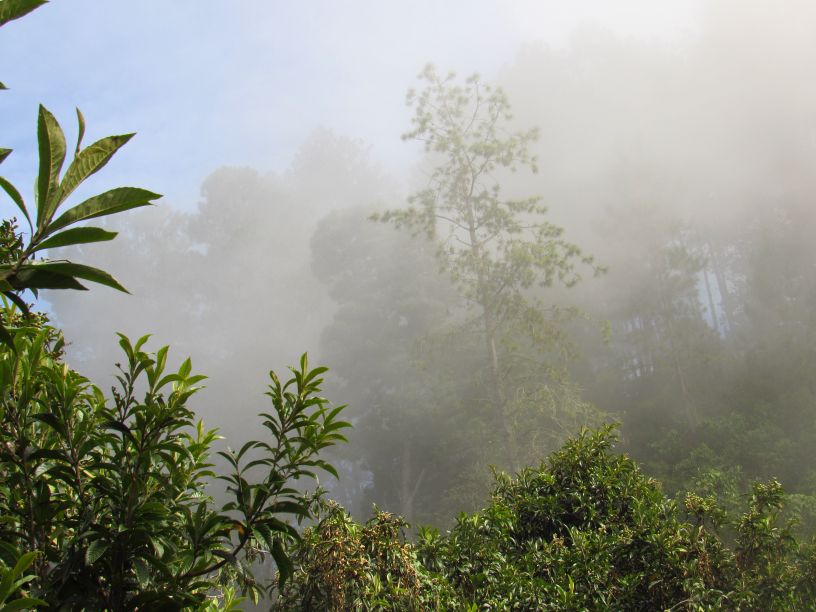
Wynne Farm – an ecological retreat near Port au Prince

Thanks to tour group Voyages Lumière, I visited the Wynne Farm located in Kenscoff, a 1.5 hour drive from Port au Prince.  I am eager to share this find with everyone interested in ecology and environmental education in Haiti.  More pictures can be seen on the Audubon Center of Les Cayes website.  

The farm is a mix of sustainable agriculture and preserved forests, and an excellent place to bring a school group or agronomy students to learn about conservation.  Janey Wynne’s father started the farm in 1950s, and the contrast to the surrounding deforested hills is striking.  Wynne Farm shows what Haiti could look like if conservation was a priority.

Tour details: Contact Voyages Lumière to arrange transportation.  Or contact the farm directly at info@wynnefarm.org.  Allow for three hours at the farm if you really want to explore and take pictures or go birding.  The early morning would be best for birding.  With a 8:45a pick up near the US Embassy, we arrived at the farm itself by 10:30a, driving most of the way to it, with the final stretch a walk down a very steep paved road (difficult if you have bad knees!).  An agronomy student doing his internship at the farm, Michard, gave me a tour of the farm, then left me to explore.  We left the farm around 1:30 and were back at the truck by 2p.


Clouds drifting through the cool forest.

Decomposition in action.
The forests of Wynne Farm in the background, deforested land in the foreground.
Eroded hillsides outside the farm boundary.

Agriculture on deforested hills surrounding the farm.