Monday, October 31, 2016

Lake Péligre


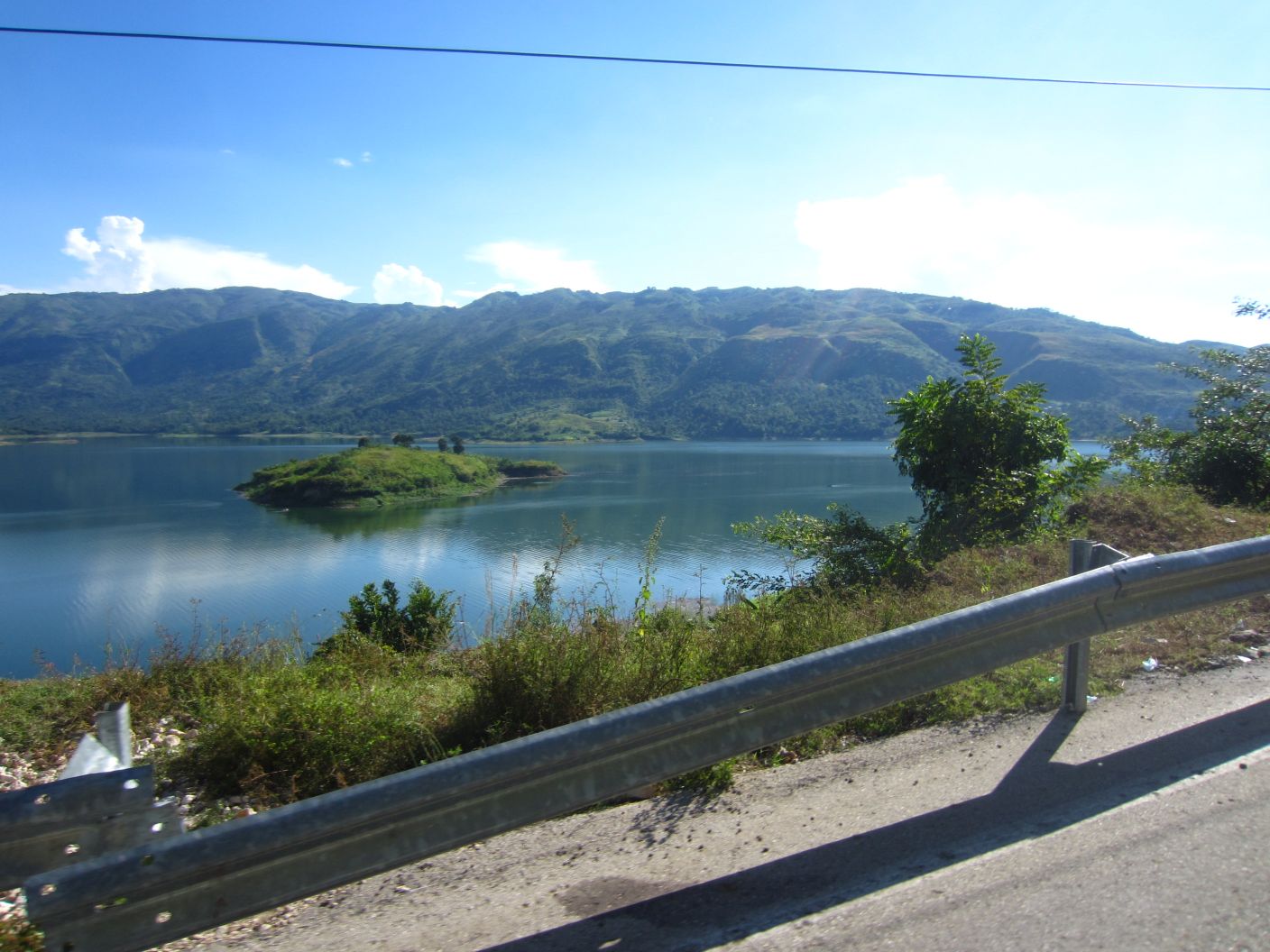
Lake Péligre, Haiti’s 2nd largest lake, is formed by a dam on the Artibonite River.  The dam was built for hydroelectric power.  The lake can be seen on National Route 3 between Hinche and Mirebalais.  You can compare lake heights in the photos below which I take every time I go past the lake.  Information on the internet suggests the lake is filling in with silt, and the turbines are not functioning at top efficiency.  As someone who receives electricity from this dam, I can tell you we have electricity a couple hours in the morning and a couple in the evening.


Peligre Lak, 2yèm pi gwo lak Ayiti a, ki te fòme pa yon baraj sou larivyè Lefrat la Latibonit. te baraj la bati pou pouvwa idwolik. ka Lak la ka wè sou Nasyonal Route 3 ant Hinche ak Mibalè. Ou ka konpare wotè lak nan foto yo anba a ki mwen pran chak fwa mwen ale sot pase lak la. Enfòmasyon sou entènèt la sijere lak la se ranpli nan ak limon, ak turbin yo pa fonksyone nan efikasite tèt. Kòm yon moun ki resevwa elektrisite sa a soti nan baraj, mwen ka di ou nou gen elektrisite yon èdtan koup nan maten an ak yon koup nan aswè an.
View 1 Oct. 2014

View 1 Dec. 2015 after a dry fall.
View 1 Oct. 2016
View 2 Oct. 2014

View 2 Dec. 2015 - note the exposed silt upstream between the hills.
View 2 Oct. 2016 the valley is full again, but shore line is still exposed.


Saturday, July 30, 2016

BirdSleuth in French - Zwazo Detektif nan Franse

The Cornell Lab of Ornithology has many birding resources, from educational materials to the eBird on-line database.  In a tropical rain forest class in the Amazon, I had a chance to try out some of their BirdSleuth materials for K-12 grade.  There is a bingo game and a scavenger hunt to get kids outside looking for birds.  You can download the French version of the materials at BirdsCaribbean.

Laboratwa a Cornell nan ornitoloji gen anpil resous gade zwazo, ki soti nan materyèl edikasyonèl nan baz done a eBird sou entènèt. Nan yon klas forè twopikal nan Amazon a, mwen te gen yon chans eseye soti kèk nan materyèl BirdSleuth (K-12). Gen se yon jwèt bengo ak yon lachas trezor yo ka resevwa timoun deyò kap chèche zwazo yo. Ou ka telechaje vèsyon an franse nan materyèl yo nan BirdsCaribbean.
Student in Peru using BirdSleuth Scavenger Hunt.
The BirdSleuth Scavenger Hunt in Spanish.
Using BirdSleuth materials in Peru during the Educator Academy in the Amazon.

Tuesday, February 16, 2016

Warblers of Haiti

Warblers are known for both migrating and being difficult to identify.  We both spend our winters in Haiti, so I get to see many of these beautiful little birds.  There’s 3 pages of small yellow birds in the Haiti field guide.  But none of the illustrations show the most common view – the underside of the bird – as seen in these photos of a prairie warbler right outside my house in Caiman (central plateau).  The Warbler Guide (2013 Princeton Univ.) has solved that problem, with many views of the birds, comparison photos, and sonograms.  It’s also available in Kindle and as an app.  


Monday, February 1, 2016

House sparrows in Caiman

Yesterday (31 Jan. 2016) was the first time I noticed house sparrows Passer domesticus in Caiman in Haiti’s central plateau (8 miles east of Pignon).  Here are photos of their nest on the campus of UCCC.  One male and 2 females or perhaps immature males.  The Birds of the DR and Haiti book says their first recorded appearance on the island was in 1976 in the DR.

Male and the 2 females or immatures next to their nest.

Female or immature?


They are in a tree near this sign.


Sunday, January 17, 2016

Eco-201 Bioassesment of Bassin Zim

On 16 January 2016 I took the Université Chrétienne de la Communauté de Caïman 1st year agronomy students in my ecology 201 class to Bassin Zim near Hinche to evaluate the water quality.  We used Lamotte water chemistry kits purchased from Carolina Biological Supply and E. coli kits purchased from Bob Metcalf who developed a portable microbiologylab (PML) to use in areas that have no electricity for incubating bacteria cultures.  The chemistry tests do not give a precise number, but are meant for use in environmental education to detect the difference between water quality extremes.  The PML does reveal if there is E.coli in the water, which means there’s fecal contamination and possibly other bacteria and viruses spread through human feces. 

We practiced all the methods in class, then at Bassin Zim used the kits to compare a stream coming from a cave about midway up the falls to the river below the falls.  We also looked at land and water use, and quality of the riparian vegetation.  The upstream site to the right of the falls is surrounded by large dense trees, perhaps reminiscent of what Haiti used to look like.  The hillside to the left and next to the river below the falls looks to be deforested, with scrubby growth that has replaced the original forest.  Our hypothesis was that the upstream site would have better water quality than the downstream site, since I assumed human activity appears to be less above the falls then at the base of the falls where people picnic, wash clothes, swim, and bring livestock.

Both sites had approximately the same chemistry, but we found E. coli in the upstream site.  Perhaps this is from the bats that roost in the cave above the site?  Unfortunately at the upstream site, a goat and chickens were drinking from the stream, and since I had visited in Nov. 2014 a tilapia pond had been installed between the stream and the falls!  There was also charcoal production right next to the forest.  That set off a lecture about needing to protect the remaining pristine places of Haiti.  I can only hope that my students will look at rivers in a new way and notice how human activities impact them, and perhaps start to make changes to restore Haiti’s natural resources.
Cave above the upstream sampling site.
Charcoal production.
The stream to the left, and unfortunate tilapia pond to the right.
Scrubby vegetation to the left, lush forest to the right.
Women washing clothes downstream of the falls.

Sunday, December 20, 2015

Monarch butterflies in Haiti

La Fouchet 20 Dec. 2015
Here are photos I took of 3 monarch butterflies in Haiti.  Two were at Wynne Farm in the mountains near Kenscoff.  One was at La Fouchet restaurant near the US embassy in Port au Prince.  If you would like exact locations, contact me.  Photos are in original resolution.  Also shown is Asclepias (milkweed) on which I saw monarchs.  It is growing by the lake Etang Lachaux near Les Cayes.

Monarch 1 at Wynne Farm, 19 Dec. 2015
Monarch 2 at Wynne Farm, 19 Dec. 2015
Milkweed by Etang Lachaux 9 Mar. 2015
Etang Lachaux 9 Mar. 2015

Saturday, December 19, 2015

Wynne Farm – an ecological retreat near Port au Prince

Thanks to tour group Voyages Lumière, I visited the Wynne Farm located in Kenscoff, a 1.5 hour drive from Port au Prince.  I am eager to share this find with everyone interested in ecology and environmental education in Haiti.  More pictures can be seen on the Audubon Center of Les Cayes website.  

The farm is a mix of sustainable agriculture and preserved forests, and an excellent place to bring a school group or agronomy students to learn about conservation.  Janey Wynne’s father started the farm in 1950s, and the contrast to the surrounding deforested hills is striking.  Wynne Farm shows what Haiti could look like if conservation was a priority.

Tour details: Contact Voyages Lumière to arrange transportation.  Or contact the farm directly at info@wynnefarm.org.  Allow for three hours at the farm if you really want to explore and take pictures or go birding.  The early morning would be best for birding.  With a 8:45a pick up near the US Embassy, we arrived at the farm itself by 10:30a, driving most of the way to it, with the final stretch a walk down a very steep paved road (difficult if you have bad knees!).  An agronomy student doing his internship at the farm, Michard, gave me a tour of the farm, then left me to explore.  We left the farm around 1:30 and were back at the truck by 2p.


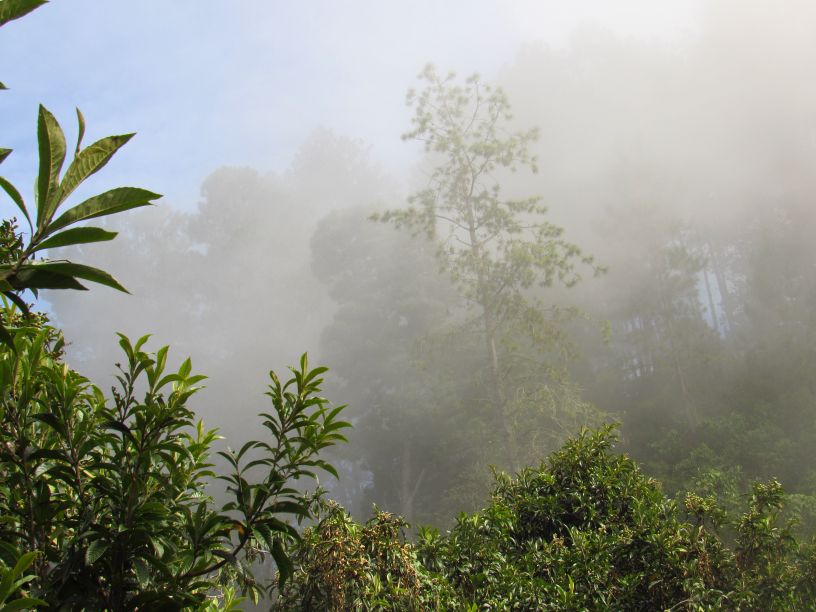
Clouds drifting through the cool forest.

Decomposition in action.
The forests of Wynne Farm in the background, deforested land in the foreground.
Eroded hillsides outside the farm boundary.

Agriculture on deforested hills surrounding the farm.