Our 2-hour lesson focused on watersheds - how what we do impacts those who live downstream of us. If we plant more trees and protect the rivers and lakes, we will have more fish and cleaner water. Washing people and vehicles and watering animals away from the river helps everyone. We finished with a lesson on microbes in water and everyone received a kit to test for E. coli in their drinking water. If you find E. coli in your water it is a sign of fecal contamination! Which means diseases such as cholera could be present. After we finished someone showed up with two bouanma fish (carp) from the Bouyara River!
Friday, February 17, 2017
Many Hands for Haiti ecology seminar
Wednesday, February 15, 2017
Well Survey – Bohoc Haiti
![]() |
| Protected Lejene well. |
Two of the
wells were in protected blue and white buildings that are kept locked and
managed by a well committee. At both
wells people drink the water without treating it, and also use it for washing
and cooking. One committee said they
treat the well once a month with chlorine, and that people must take off their
shoes before entering the building. People at the Caiman well said they do not
drink the water, but use it for cooking and washing. At a second unprotected well, someone said
that some people drink the well water but shouldn’t.
![]() |
| Caiman well. |
The results
of this study were shared with the well committee and users, with cautions to
those at the unprotected wells to avoid giving this water to babies.
Tuesday, November 29, 2016
Bird Sleuth
I teach
ecology programs in a rural village in central Haiti, and at an elementary
school. This week we used the BirdSleuth scavenger hunt and Bird Spy Bingo produced by the Cornell Lab of
Ornithology. The games are printed on
slick cards on which dry erase markers can be erased. I only have the English version of the games
since I am waiting for the French to be reprinted. The scavenger hunt has basic and more
advanced levels of finding objects in natures such as a spider web, rock, leaf,
etc., and is mostly text, so I had the kids find the objects that were pictured
on the cards. Bird bingo has birds doing
various things, such as sitting on a branch or singing, and the kids were able
to follow the illustrations. The 6th
graders were able to read some of the English descriptions of the birds. There aren’t many trees in the village and
the kids are noisy, but a kestrel did pose on a tree for us, and the kids found
a feather and bird droppings. We saw a
few more birds near the elementary school.
Binoculars aren’t needed for the scavenger hunt, but make the bingo more
fun. Both games draw attention to
animals and objects found in nature. My
assistant Louiders wants me to thank everyone who donates binoculars and funds
for this! He says you are helping Haiti!![]() |
| Searching for birds along the village path. |
![]() |
| Bird Bingo in the village. |
![]() |
| Louiders helping the 6th graders. |
Monday, November 21, 2016
Stream Survey – Bohoc Haiti
![]() |
| Tilapia pond in UCCC gardens |
On 14 Nov.
2016 we performed a brief survey of two rivers and a spring in Bohoc Haiti,
near the market along National Route 3. Bohoc
is 8 miles east of Pignon. We collected
water samples to measure nitrate, phosphate, DO, and pH with LaMotte® Water
TesTab® Kits and determine fecal coliform counts with 3M petrifilm. We also used a 500 micron D net to sweep the
substrate and overhanging vegetation for macroinvertebrates that we identified
to lowest taxon possible in the field.
In the Université de la Communauté Chrétienne de Caïman (UCCC) gardens
to the south of Rt. 3 we sampled two hand-dug tilapia ponds, the Bohoc River
which is downhill of the ponds and gardens, and an irrigation canal that flows
through the gardens and feeds the tilapia pond.
We also sampled the Sous Chaude (hot spring) and receiving river located
downhill behind the Bohoc Market, to the north of Rt. 3. We returned to the spring 17 Nov. to measure
water temperature. All sites were high
in phosphate (4 mg/l), and fecal coliform (>7 colonies) except for the Sous
Chaude which had no coliform bacteria and had lower phosphate (1 -2 mg/l). At all sites dissolved oxygen was <4 mg/l,
nitrate-N was 1.03 mg/l (5 mg/l nitrate-NO3), and pH was 7 to 8.
The Lamotte
kits measure water chemistry parameters in discrete categories determined by
color change. All coordinates were taken
with handheld GPS except for sites 2 and 6 which were estimated from Google
Earth.
![]() |
| Bohoc River downhill from UCCC tilapia pond, looking up from Site 3 pool |
![]() |
| Bohoc River downhill from UCCC tilapia pond, Site 3 pool |
![]() |
| Chara? from site 4 irrigation canal in UCCC garden. |
![]() |
| Site 4 irrigation canal in UCCC garden. |
![]() |
| Bohoc River fall in site 5 (upstream of path that crosses) |
![]() |
| Crab found on fall at site 5 Bohoc River |
![]() |
| Site 6 Sous Chaude behind Bohoc Market |
![]() |
| Site 7 Sous Chaude outflow on left, site 8 river upstream on right. |
![]() |
| 3M petrifilm plates, with E. coli colonies in blue. |
Haitian Studies Association Conference – Cap Haitien
Dr. Huggins and I presented our 2015 lake study (KBS Report181) at the 28th Annual Haitian Studies Association Conference (10 –
12 Nov. 2016) in Cap Haitien on the north coast of Haiti. The theme of this year’s conference was Haiti’s
Ecosystems: Focus on Environmental Realities and Hopes. A plenary session was about water quality and
a related book of aquatic research was provided. Other topics ranged from the portrayal of the
environment in Haitian literature, to citizen perception of environmental
issues, to caves and archeology. The
conference began Thursday with an emerging scholars session at Université
Publique du Nord au Cap Haitien south of Cap.
Most of the presentations and activities were at the hotel Auberge Villa
Cana on National Rt. 1. Saturday’s talks
were presented at the Campus Henri Christophe de l'UEH a Limonade, about 40
minutes east of Cap. Cap was flooded
from a heavy rain that fell four days before the conference, and every evening
it rained, flooding parts of Rt. 1. We
stayed in the Hotel Imperial which sat far enough back from the road to avoid
flooding. Two of my ecology students from UCCC joined us.Monday, October 31, 2016
Lake Péligre

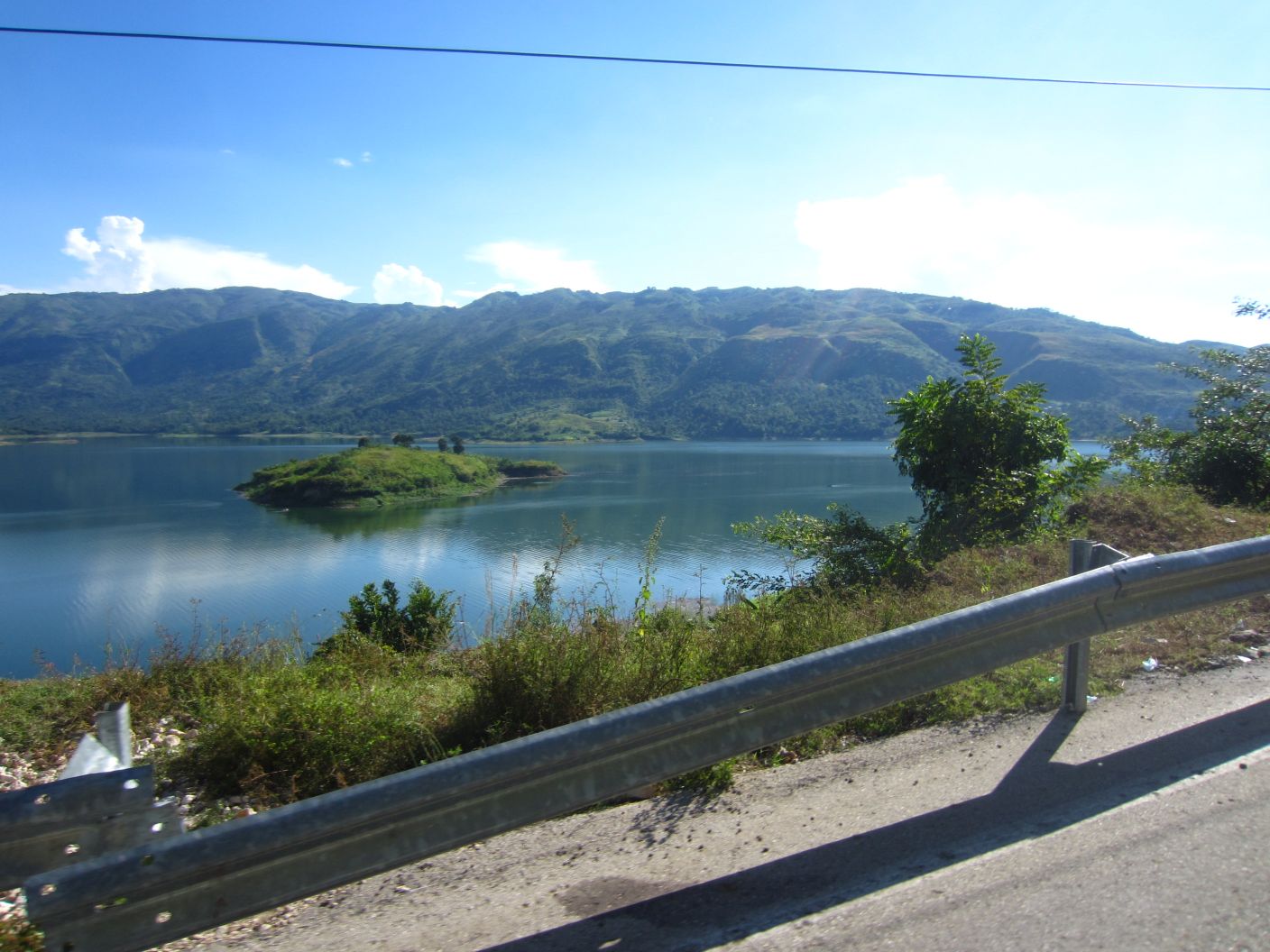
Lake Péligre, Haiti’s 2nd largest lake, is formed by a dam
on the Artibonite River. The dam was
built for hydroelectric power. The lake
can be seen on National Route 3 between Hinche and Mirebalais. You can compare lake heights in the photos
below which I take every time I go past the lake. Information on the internet suggests the lake
is filling in with silt, and the turbines are not functioning at top
efficiency. As someone who receives electricity
from this dam, I can tell you we have electricity a couple hours in the morning
and a couple in the evening.
Peligre Lak, 2yèm pi gwo lak Ayiti a, ki te fòme pa yon
baraj sou larivyè Lefrat la Latibonit. te baraj la bati pou pouvwa idwolik. ka
Lak la ka wè sou Nasyonal Route 3 ant Hinche ak Mibalè. Ou ka konpare wotè lak
nan foto yo anba a ki mwen pran chak fwa mwen ale sot pase lak la. Enfòmasyon
sou entènèt la sijere lak la se ranpli nan ak limon, ak turbin yo pa fonksyone
nan efikasite tèt. Kòm yon moun ki resevwa elektrisite sa a soti nan baraj,
mwen ka di ou nou gen elektrisite yon èdtan koup nan maten an ak yon koup nan
aswè an.
![]() |
| View 1 Oct. 2014 |
![]() |
| View 1 Dec. 2015 after a dry fall. |
![]() |
| View 1 Oct. 2016 |
![]() |
| View 2 Oct. 2014 |
![]() |
| View 2 Dec. 2015 - note the exposed silt upstream between the hills. |
Saturday, July 30, 2016
BirdSleuth in French - Zwazo Detektif nan Franse
The Cornell Lab of Ornithology has many birding resources, from educational materials to the eBird on-line database. In a tropical rain forest class in the Amazon, I had a chance to try out some of their BirdSleuth materials for K-12 grade. There is a bingo game and a scavenger hunt to get kids outside looking for birds. You can download the French version of the materials at BirdsCaribbean.
Laboratwa a Cornell nan ornitoloji gen anpil resous gade zwazo, ki soti nan materyèl edikasyonèl nan baz done a eBird sou entènèt. Nan yon klas forè twopikal nan Amazon a, mwen te gen yon chans eseye soti kèk nan materyèl BirdSleuth (K-12). Gen se yon jwèt bengo ak yon lachas trezor yo ka resevwa timoun deyò kap chèche zwazo yo. Ou ka telechaje vèsyon an franse nan materyèl yo nan BirdsCaribbean.
| Student in Peru using BirdSleuth Scavenger Hunt. |
| The BirdSleuth Scavenger Hunt in Spanish. |
| Using BirdSleuth materials in Peru during the Educator Academy in the Amazon. |
Subscribe to:
Posts (Atom)