Tuesday, November 4, 2014

Ramye (plain pigeon) in the central plateau

There is a confirmed pair of ramye, plain pigeon (Patagioenas inornata), near l'Université Chrétienne de la Communauté de Caïman east of Pignon.  Here is video so you can hear their low groan.  Turn the volume up and listen at seconds 3, 11, and 20.  The birds fly off at second 31.

Older Haitians say that when they were young they saw 100s of these birds at a time.  Now there is reported to be only 1,000-4,000 in the Caribbean.  The ramye have been seen in other places near Caiman and Bohoc since 2009.


Friday, April 18, 2014

Mystery freshwater plant of Haiti

This fall we will be back at Etang Laborde to perform a bioassessment which will document the plant and animal life at this lake.  During our reconn we found this plant growing along the shore along with other aquatic plants.  Does anyone know what it is?
What is the plant on the left?

What is this plant?

Saturday, March 22, 2014

Ecotours in Les Cayes

If you are interested in ecotours around the Les Cayes area, visit our sister blog site to read about birding, forts, caves, and other sites you can explore.


Tuesday, February 11, 2014

Turtles and amphibians of southern Haiti

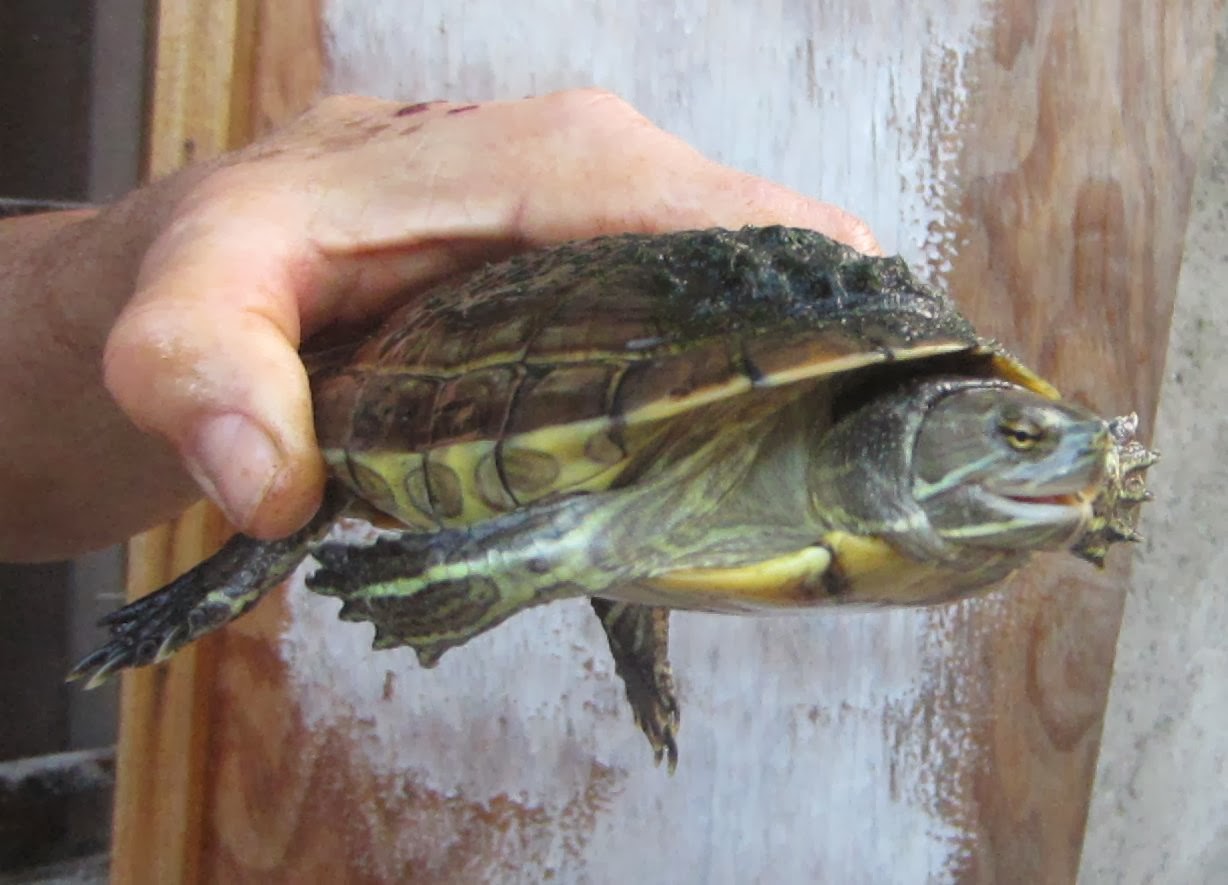
The Audubon Center appreciates all nature, not just birds.  Here are some photos of turtles and frogs found in the Les Cayes area.  Does any one know which species they are?

Frogs A & B - This is the invasive species the Cane toad, or Marine toad.  They secret a toxin that can kill small mammals and harm humans, and they eat Haiti's native animals. 


C'est l'espèce invasive le crapaud de canne, ou crapaud marin. Ils secrète une toxine qui peut tuer les petits mammifères et les humains de nuire, et ils mangent les animaux indigènes d'Haïti. 


Frog C is most likely Eleutherodactylus abbotti.

The turtle is most likely Trachemys stejnegeri, though the range map on CaribHerp indicates it may be the other native freshwater turtle Trachemys decorata.


Frog A - Etang Lachaux

Frog A - Etang Lachaux

Frog B - Etang Laborde

Frog C - Les Cayes.

Frog C - Les Cayes.

Frog C - Les Cayes.

Turtle A
Turtle A
Turtle A


Wednesday, February 5, 2014

A 1931 Book of Birds of Haiti

I recently purchased the 1931 book 'The Birds of Haiti and the Dominican Republic' by Alexander Wetmore and Bradshaw H. Swales.  The book begins with a review of natural history surveys done on the island since the arrival of Columbus.  Then gives a summary of the avifauna in various regions of the island.  It also gives accounts of the bird species found on the island.  My attention was drawn to references of parrots and parakeets being common.  There are some black and white photos from the 1927 birding expedition, as well as black and white illustrations of some of the birds.  I plan to compare the bird list in this book with that of the 2006 Princeton Birds of the Dominican Republic and Haiti.  Visit the Audubon Center Facebook page for photos from this glimpse into history.  https://www.facebook.com/audubonhaiti


Thursday, January 30, 2014

A visit to Etang Laborde


In December 2013 I had visited Etang Laborde for the Les Cayes Christmas Bird Count.  This month I had the opportunity to return to the lake when my guest, aquatic ecologist Dr. Donald Huggins, wanted to visit it for a possible bioassessment study.  In May 2013 we had done a base-line bioassessment of nearby Etang Lachaux, which continued to recede in the 2013 drought.  Now we needed to see a lake that still had water, fish, and birds.  The residents along the lake were very kind to us, telling us about the history of the lake levels and giant fish and crayfish they had seen.  Our botanist friend Dr. Craig Freeman identified the aquatic plants from photos we had taken (see next post).  The large flocks of ducks I saw during the Christmas count had moved on, but still we saw over 19 species of birds.


People use these springs for drinking water.  They are about 15 m from the lake shore. 

Drawing by a man who said he saw a fish almost 1 m long.


Sunday, January 19, 2014

2nd Aquatic Ecology Workshop in Camp Perrin


Thank you to Jean Dunes Gustave, Ministry of the Environment for the South, for inviting the University of Kansas (KU) to hold a second aquatic ecology workshop at his office building in Camp Perrin.  This 2ème Les Principes Écologie Aquatique focused on the results of our May 2013 study of Etang Lachaux, a lake along National Route 7 south between Les Cayes and Camp Perrin.  See these past blogs for the lake study and the 1st workshop in May 2013.  The 29 participants represented 13 organizations and including people who owned land around the lake.  Presenters were Dr. Donald Huggins from the Kansas Biological Survey (KBS) at KU and Debbie Baker from KBS and Audubon Center of Les Cayes.

We discussed the results of the water chemistry of the lake, and gave recommendations for increasing water volume so that the lake can be used for a fishery.  Participants said that 1975 was the last time the lake completely dried up.  We suggested that lake managers do not stock this shallow lake with carp which are bottom feeders and stir up the lake sediment.